How high may a private parking compensation claim be for illegal parking in Switzerland?
How high may a private parking compensation claim (Umtriebsentschädigung) be in Switzerland? Learn which amounts are considered appropriate, how to enforce claims legally, and which mistakes to avoid.

 Driver tips3 min read
Overview.
How high may a private parking compensation claim (Umtriebsentschädigung) be in Switzerland? Learn which amounts are considered appropriate, how to enforce claims legally, and which mistakes to avoid.
Table of contents
In Switzerland more and more private individuals and businesses face a growing problem: vehicles parked without authorisation on private parking spaces or company premises. To counter this disturbance, Swiss law permits a so-called Umtriebsentschädigung — a flat-rate reimbursement for the effort incurred. But how high may this amount actually be? Where is the line between a justified claim and overreach?
Legal situation: not a fine, but reimbursement of costs
Unlike state-issued public-order fines, the Umtriebsentschädigung is based not on public law but on civil law. Its basis is Art. 41 of the Swiss Code of Obligations (OR): anyone who acts unlawfully and thereby causes damage must compensate for it.
Important: the Umtriebsentschädigung is not a punishment but is intended to cover the actual effort — for example research, correspondence or documentation of the incident.
The decisive point is that it is not a penalty, but a real reimbursement for the effort caused by the illegal parking.
How high may the compensation be?
In practice, certain guidelines have become established:
- CHF 40 to 80 is currently considered an appropriate range.
- In more serious cases — for example repeated illegal parking or additional effort — amounts of up to CHF 100 are possible.
- Anything above that (e.g. CHF 150) is only enforceable if the additional effort can be documented in full.
Courts pay close attention to proportionality. Asking too much risks having the claim rejected.
How to make your claim legally watertight
To enforce a compensation claim legally, the following are advantageous:
Signage. Notice boards like "Private parking — unauthorised vehicles will be charged" create transparency and strengthen your legal position.
Complete documentation. Photos of the vehicle, the parking sign and the licence plate, plus a precise timestamp, are essential. A list of the work steps (research, contact attempts, etc.) increases credibility.
Maintain proportionality. Claims above CHF 100 without solid evidence are usually rejected by courts — even when the violation was unambiguous.
Enforcement in practice
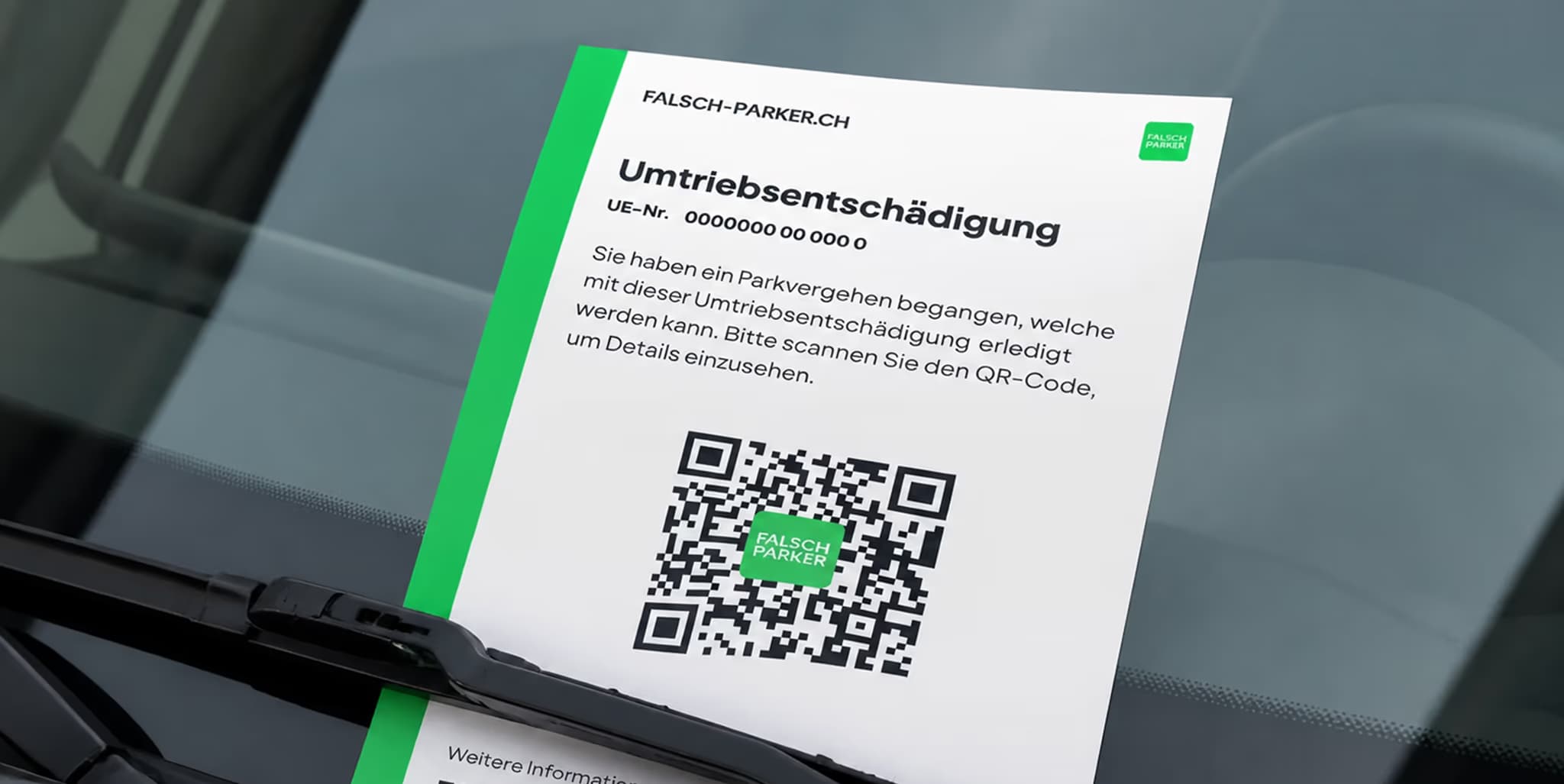
Many owners and possessors shy away from the effort or from direct conflict with the illegal parker. Specialised providers such as Falsch-Parker.ch step in here: they handle documentation, the claim and collection, making the process straightforward for those affected.
This model is growing in popularity, especially in cities like Zurich, Basel or Lausanne, where parking is particularly scarce. It not only relieves the burden but also acts as a long-term deterrent.
Conclusion: fair compensation with a sense of proportion
The Umtriebsentschädigung is a legitimate tool against unauthorised parking — but only as long as it stays within reasonable bounds. Anyone aligning with the CHF 40–80 range is on safe ground. Higher amounts must be well-justified and cleanly documented.
For owners or possessors affected regularly, a systematic approach pays off — or working with professionals. That way the Umtriebsentschädigung remains what it should be: a fair compensation, not an inflated fine.
Protect your parking spot today.
Falsch-Parker helps property owners and tenants enforce private parking rules — without paperwork.
Get started